Ruhr Art Trail
17 works of art along the route
Ruhr Art Trail
Art Emerges—RWE Installs 17 Works of Art Along the RuhrtalRadweg.
From a secluded stream to the world’s largest inland port; from a medieval idyll of castles and half-timbered houses through impressive industrial cultural landscapes to the postmodern charm of the harbor; from secluded forest trails to well-developed promenades along the Ruhr River—the RuhrtalRadweg is all about contrasts! Since mid-2010, 17 works of art have enriched the diversity of the 240-kilometer route along the Ruhr River.
As part of the European Capital of Culture Ruhr.2010, the company RWE launched a competition for students in art and design programs. A total of eleven artistic concepts were selected and realized over the course of the summer of 2010; at 17 locations along the RuhrtalRadweg, they now engage in an artistic dialogue with RWE’s technical landmarks. A total of 60 artists from the Münster Academy of Fine Arts, the Folkwang University of the Arts in Essen, the Free Academy of Fine Arts in Essen, and the design program at Dortmund University of Applied Sciences and Arts participated in the ideas competition.
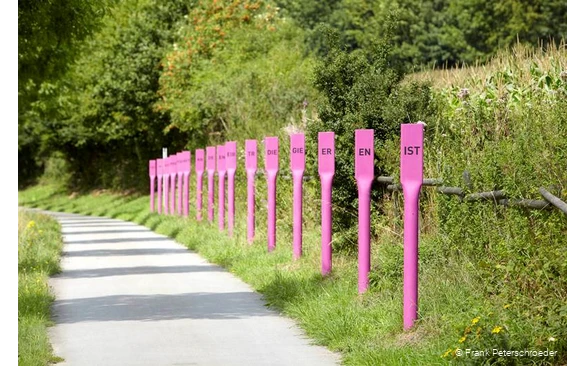
An expert jury composed of external art experts and RWE technicians selected original and unconventional approaches that open up new perspectives on the topic of energy: A local distribution substation deep in the Sauerland region near Winterberg reveals an erotic-energetic seduction through the video installation “Watt’n dat?” A circle of gas marker posts titled “CRE:SIGN” gives passersby food for thought with a pithy saying. Five telescopes, positioned at various locations in line with the “Targeting Energy” concept, playfully and colorfully alter the view of high-voltage pylons, streetlights, and power plants. Photo installations that—like a scavenger hunt—blend into the technical environment line the path as “supports,” “coil sections,” and “valves.”
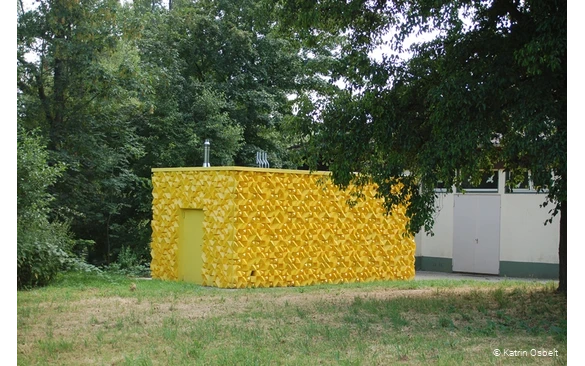
The artworks become a connecting element between nature and technology. Whether in “primus inter pares,” where a gray utility marker post leads a pack of yellow marker posts toward the Ruhr, or the moss-covered and plant-entwined “Green Mound” cozily envelops a gas station; whether a colorfully iridescent high-voltage pylon, as “Lighthouse” colorfully refracts the sunlight, or an oversized switchgear structure with an integrated birdhouse called “offline” amazes passersby—anyone who slows down finds themselves asking in a new way: How is energy generated, converted, and transported? The optical illusion “Moving Bikes” sets both mind and body in motion: Depending on your perspective and speed, the nearly life-size photographs on a building wall appear to start rolling. And on Neheim’s town hall square, a gas station encased in bright yellow diffuser panels is already the talk of the town.